
Grading Syllabus (Kata Names and Meanings)
Taikyo Kyu Katas
(Taikyo Kyu Katas practiced in First Six to Eight months and tested for the (9th Kyu)
1st STRIPE or RED BELT for Children)
These are the most elementary katas practiced - Developed by Master Funakoshi’s son, Gigo, Taikyoku helps new students learn basic kata principles.
(Taikyo Kyu Katas practiced in First Six to Eight months and tested for the (9th Kyu)
1st STRIPE or RED BELT for Children)
These are the most elementary katas practiced - Developed by Master Funakoshi’s son, Gigo, Taikyoku helps new students learn basic kata principles.
|
Taikyo Kyu Yondan
35 seconds Taikyo Kyu Godan
35 seconds Taikyo Kyu Rukudan
30 seconds |
First Cause First Level
First Cause Second Level
First Cause Third Level
First Cause Fourth Level
First Cause Fifth Level
First Cause Sixth Level
|
Heian Katas
The word Heian is a mixture of the syllables for Heiwan and Antei = Peacefulness' and Calmness which signifies a peaceful mind, taken from the city of Heian
See Detailed Heian Kata Diagrams
The word Heian is a mixture of the syllables for Heiwan and Antei = Peacefulness' and Calmness which signifies a peaceful mind, taken from the city of Heian
See Detailed Heian Kata Diagrams
|
Peaceful Mind 1st Level
Test Kata For The (8th Kyu) YELLOW BELT 1st Level Peaceful Mind 2nd Level
Test Kata For The (7th Kyu) Orange Belt Peaceful Mind 3rd
Test Kata For The (6th Kyu) ORANGE BELT 2nd Level Peaceful Mind 5th Level
Test Kata For The (4th Kyu) PURPLE BELT |
Kenseikan Katas - Exclusive
Please click Katas below to watch:
|
Power of Fist, Mind & Honesty 1st Level
Test (8th Kyu) YELLOW BELT Power of Fist, Mind & Honesty 2nd Level
Test (7th Kyu) ORANGE BELT 1st Level Power of Fist, Mind & Honesty 3rd Level
Test (6th Kyu) ORANGE BELT 2nd Level Power of Fist, Mind & Honesty 4th Level
Test (5th Kyu) GREEN BELT Power of Fist, Mind & Honesty 5th Level
Test (4th Kyu) PURPLE BELT |
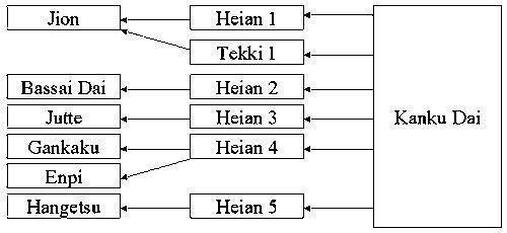
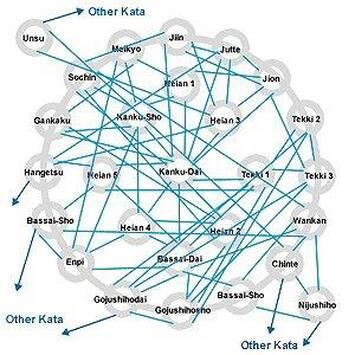
Backbone of Shotokan KATAs
|
|
|
Gankaku
42 Moves 60 Seconds Goju Shi Ho Dai
67 Moves 90 Seconds Goju Shi Ho Sho
65 Moves 90 Seconds Meikyo
33 Moves 60 Seconds Niju Shi Ho
24 Moves 60 Seconds Unsu
48 Moves 60 Seconds |
(Iron Horseman) Horse Riding 1st Level
Test Kata for the (3rd Kyu) BLUE BELT (Originally known in Okinawa as Naihanchi) The katas were renamed by Master Funakoshi upon its introduction to Japan to reflect the strength exhibited with kiba-dachi. Rich in fighting techniques, the Tekki family offers a plethora of close combat techniques) Also Creates a strong stance (Kiba Dachi) and develops the waist and torso area alike. Horse Riding 2nd Level, Test Kata for the (3rd Kyu)
BROWN BELT Horse Riding 3rd Level, Test Kata for the (2nd Kyu)
BROWN BELT Senior (2nd Level) one stripe To penetrate a Fortress (Major),
Also means Credit where it is due Test Kata for the (1st Kyu) BROWN BELT Senior (2nd Level) one stripe The strong techniques of this kata emphasize hip movement. Some resemble a battering ram being used against fortress walls. This kata signifies the internal battle for control of the self (Sentei kata). To penetrate a fortress (Minor)
This kata was derived from Bassai-Dai. It has a similar performance line. (Advanced - Nakayama) Vewing the Sky (Major), (1st DAN) Test Kata Plus all the Katas
learnt above and One Kata from below BLACK BELT Most of the elements of the Heian Kata were derived from this kata. The first movement in this kata views the sky, which symbolizes the universe and shows your opponent that you are unarmed. It was Master Funakoshi’s preferred kata. Shitei Kata) Viewing the Sky (Minor) (Advanced - Nakayama)
Half Moon This kata received its name from its
principal stance, hangetsu dachi (half moon stance) (Advanced - Nakayama) Flying Swallow The quick up and down movements of
this kata are reminiscent of a fling swallow. Enpi is one of the oldest kata in Shotokan. Its former name was Wanshu. (Shitei Kata) Crane on a rock. The main stance in this kata (tsuruashi
dachi) resembles a crane ready to strike at its prey. The movements are supposed to simulate a fight in the narrow alleyways of Okinawa. The former name of this kata was Chinto. (Advanced - Funakoshi) Ten Hands (sometimes spelt JUTTE)
The goal of this kata is to teach a student to fight against ten opponents. This is a strong kata, similar to jion and Jiin. (Advanced - Funakoshi) From the temple of Jion (love and goodness) Jion is a term in Buddhism. It is also the name of a temple in China. It uses basic stances and techniques. It is one of the most traditional kata in Shotokan. (Sentei Kata) Temple grounds (love and shadow)
Jiin is another term in Buddhism. It has similar techniques and performance line as Jion. Also could mean "Temple Grounds" referring to JIon-Ji (monastery) (Advanced - rare) Strength and Calm ("Reason profound"-Funakoshi)
The name of this kata comes from its stance (sochin dachi), a strong, rooted stance. The purpose of this kata is to teach defense against a stick. Its former name was Hakko. (Advanced - Nakayama) Fifty four steps – big) This kata is one of the most
advance kata of Shotokan. Master Funakoshi called it hotaku (knocking of a oodpecker) because some of the techniques resemble a woodpecker tapping its beak against a tree. (Advanced - Nakayama) Fifty four steps – small) This is a smaller version of Goju Shi
Ho Dai. It is also one of the most advanced kata of Shotokan (Advanced - Nakayama) Bright mirror The first movements of this kata suggest the smoothing
of water to make it as calm and even as a mirror. The triangle jump at the end of this kata is said to have a secret meaning portending to a miracle. (Advanced - Nakayama) Twenty-four steps The movements in this kata resemble waves
breaking on a cliff. The former name of this kata was ni sei shi. (Advanced - Nakayama) King and crown (or King's/Emperor's Crown).
Wankan is the shortest kata in Shotokan (Advanced - rare) Rare hand. Chinte has a lot of circular and roundhouse techniques.
These are rare and are not typical of the shortest distance between two points concept of Shotokan. (Advanced - Nakayama) Cloud hands. Unsu has several techniques that symbolize parting
the clouds with open hands. It is also one of the most advanced kata of Shotokan. (Advanced - Nakayama) |
Importance of learning Kata correctly: "In the past, it was expected that about three years were required to learn a single kata, and usually even an expert of considerable skill would only know three, or at most five, kata.” – Gichin Funakoshi (founder of Shotokan Karate) |
